English to Tagalog: 101 Essential Words and Phrases (With Meanings + Examples)
Heads up: This post contains affiliate links. That means if you click and buy something I recommend, I may earn a small commission at no extra cost to you. Thank you for supporting my blog!
Introduction
So, you’ve got an upcoming trip to the Philippines, and you’re feeling a little nervous that you might get lost in translation because you don’t know the language. Don’t worry—I’ve got you covered!
Filipinos are known for their warmth and hospitality, and most can speak English. If you don’t understand Tagalog, they’ll happily switch to English to help you out. But here’s the thing: making the effort to learn and use a few Tagalog words shows respect, builds connection, and often earns you an extra-big smile. Even a simple “Salamat” (thank you) can go a long way.
This guide gives you 101 essential English-to-Tagalog words and phrases—complete with meanings, phonetic spelling, and real-life examples.
👉 Pro tip: Don’t stress about perfect grammar. Filipinos will warmly appreciate your effort, even if you only say “Salamat.”
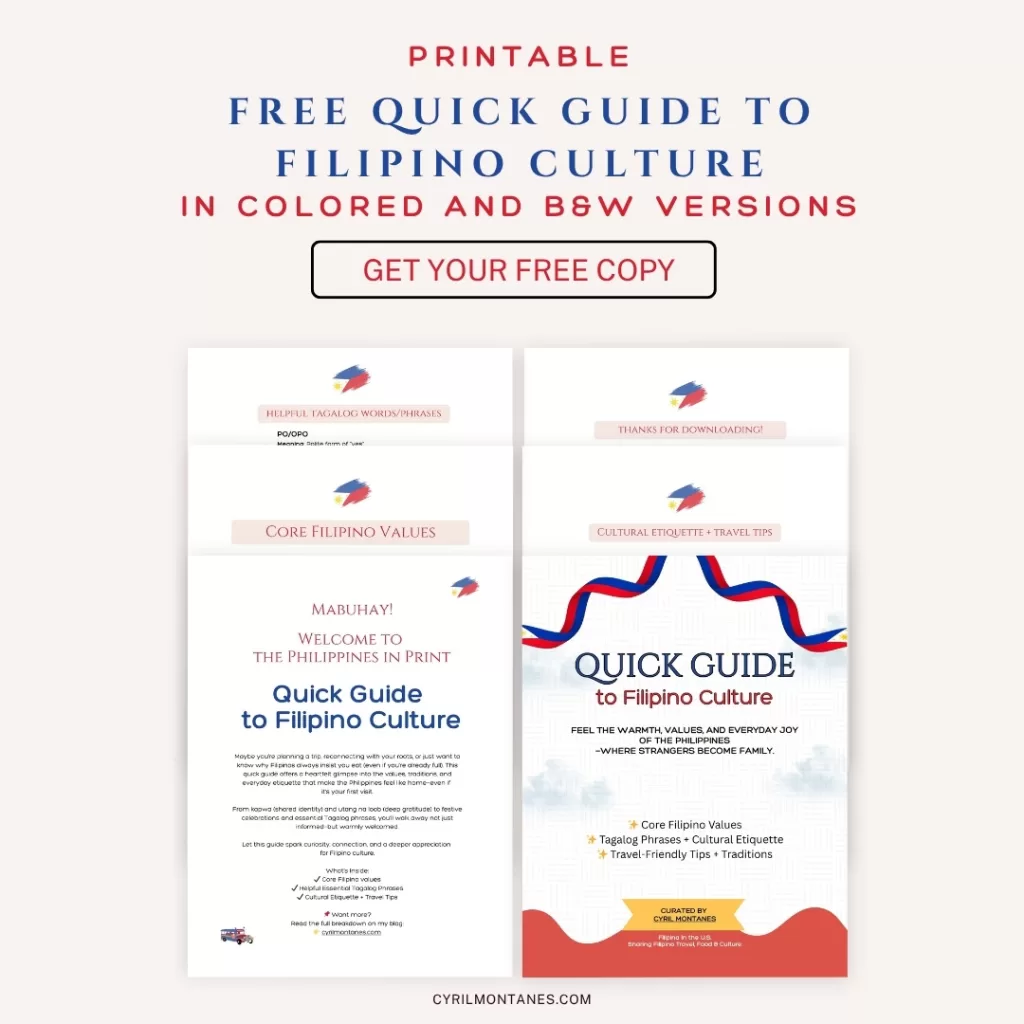
Want to practice these phrases the Filipino way?
Download my FREE Quick Guide to Filipino Culture — it’s packed with values, etiquette, and travel tips that bring these words to life.
Watch & Learn Tagalog Faster
Learning pronunciation is much easier when you hear the words. Check out my growing YouTube playlist of Tagalog words & phrases with pronunciation — perfect to practice along as you read this guide.
Watch the Playlist on YouTube: Tagalog Made Easy: Words, Phrases & Pronunciation
Greetings and Polite Expressions
- Hello – Kamusta (kah-MOOS-tah)
- Example: Kamusta ka? (How are you?)
- Good morning – Magandang umaga (mah-GAN-dahng oo-MAH-gah)
- Example: Magandang umaga, Juan! (Good morning, Juan!)
- Good afternoon – Magandang hapon (mah-GAN-dahng HAH-pon)
- Example: Magandang hapon sa inyong lahat. (Good afternoon to all of you.)
- Good evening – Magandang gabi (mah-GAN-dahng gah-BEE)
- Example: Magandang gabi, kumain ka na ba? (Good evening, have you eaten?)
- I’m fine – Mabuti ako (mah-BOO-tee ah-KOH)
- Example: Mabuti naman ako, salamat! (I’m fine, thank you!)
- Thank you – Salamat (sah-LAH-maht)
- Example: Salamat sa tulong mo. (Thank you for your help.)
- Thank you very much – Maraming salamat (mah-RAH-ming sah-LAH-maht)
- Example: Maraming salamat sa pagkain. (Thank you very much for the food.)
- You’re welcome – Walang anuman (wah-LAHNG ah-noo-MAHN)
- Example: Walang anuman, masaya akong tumulong. (You’re welcome, I’m happy to help.)
- Sorry – Pasensya (pah-SEN-shah)
- Example: Pasensya na, nahuli ako. (Sorry, I was late.)
- Please – Pakiusap (pah-kee-OO-sahp)
- Example: Pakiusap, pakiabot ng tubig. (Please, pass the water.)
- Yes – Oo (OH-oh)
- Example: Oo, pupunta ako bukas. (Yes, I’ll go tomorrow.)
- No – Hindi (hin-DEE)
- Example: Hindi ako gutom. (I’m not hungry.)
- Maybe – Siguro (see-GOO-roh)
- Example: Siguro uulan bukas. (Maybe it will rain tomorrow.)
- Goodbye – Paalam (pah-AH-lahm)
- Example: Paalam na, kita tayo bukas. (Goodbye, see you tomorrow.)
- Take care – Ingat (EE-ngaht)
- Example: Ingat ka sa biyahe! (Take care on your trip!)
🌟 Bonus: Po and Opo (Respect Markers)

- Po – Added to sentences to show respect, especially to elders or authority figures. Example: Salamat po. (Thank you, with respect.)
- Opo – Polite way of saying “Yes,” when talking to someone older or in authority. Example: Teacher: “Naiintindihan mo ba?” (Do you understand?) Student: “Opo.” (Yes, with respect.)
👉 Related Reading: How to Say Hello in Tagalog
Common Everyday Words

- Friend – Kaibigan (kah-ee-BEE-gan)
- Example: Si Pedro ay kaibigan ko. (Pedro is my friend.)
- Love – Pag-ibig (pahg-EE-big)
- Example: Ang pag-ibig ay mahalaga. (Love is important.)
- Happy – Masaya (mah-sah-YAH)
- Example: Masaya ako ngayon. (I am happy today.)
- Sad – Malungkot (mah-loong-KOT)
- Example: Malungkot siya dahil umuulan. (He/She is sad because it’s raining.)
- Beautiful – Maganda (mah-gan-DAH)
- Example: Maganda ang tanawin dito. (The scenery here is beautiful.)
- Handsome – Gwapo (GWAH-poh)
- Example: Gwapo ang kapatid mo. (Your brother is handsome.)
- Big – Malaki (mah-lah-KEE)
- Example: Malaki ang bahay nila. (Their house is big.)
- Small – Maliit (mah-lee-IT)
- Example: Maliit ang aso ko. (My dog is small.)
- Hot – Mainit (mah-EE-nit)
- Example: Mainit ang kape. (The coffee is hot.)
- Cold – Malamig (mah-lah-MEEG)
- Example: Malamig ang tubig. (The water is cold.)
💡 Pro Tip: Want more everyday expressions beyond this list?
Check out the Easy Tagalog Phrase Book — it’s packed with quick, useful phrases you can practice anytime. (Affiliate link)
Pronouns
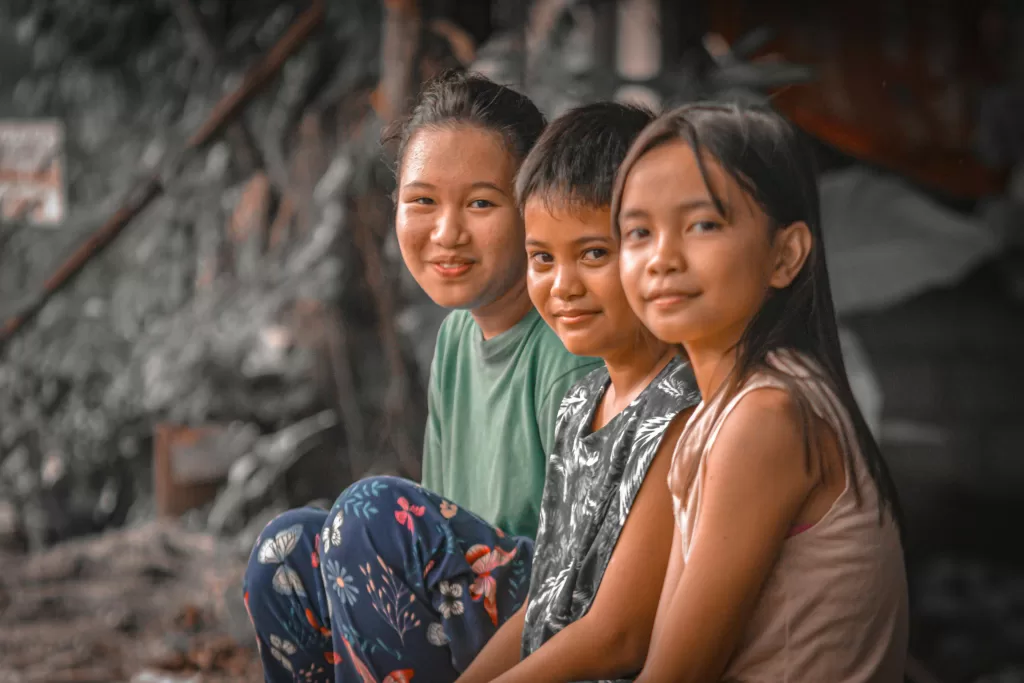
- I / Me – Ako (ah-KOH)
- Example: Ako ay masaya. (I am happy.)
- You (singular) – Ikaw / Ka (ee-KAW / kah)
- Example: Ikaw ang guro ko. (You are my teacher.)
- Example: Kumain ka na ba? (Have you eaten?)
- He / She – Siya (SHAH)
- Example: Siya ay maganda. (She is beautiful.)
- We (inclusive: you + me) – Tayo (TAH-yoh)
- Example: Tayo ay pupunta sa simbahan. (We are going to church.)
- We (exclusive: not you) – Kami (kah-MEE)
- Example: Kami ay kakain na. (We [not you] will eat now.)
- You (plural) – Kayo (kah-YOH)
- Example: Kayo ba ay handa na? (Are you all ready?)
- They / Them – Sila (see-LAH)
- Example: Sila ay mababait. (They are kind.)
Numbers
- One – Isa (ee-SAH)
- Example: Isa lang ang libro ko. (I only ave one book.)
- Two – Dalawa (dah-lah-WAH)
- Example: Dalawa ang aso nila. (They have two dogs.)
- Three – Tatlo (taht-LOH)
- Example: Tatlo ang anak ni Maria. (Maria has three children.)
- Four – Apat (AH-paht)
- Example: Apat na estudyante ang nandito. (There are four students here.)
- Five – Lima (lee-MAH)
- Example: Lima ang mangga sa mesa. (There are five mangoes on the table.)
Family and Relationships
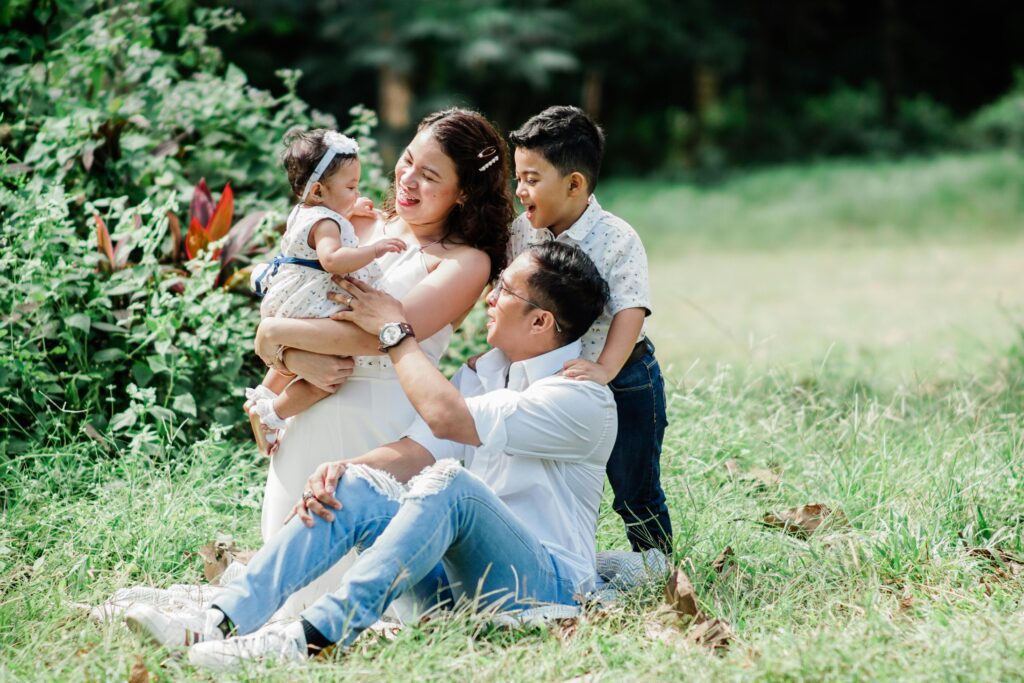
- Mother – Nanay / Ina (NAH-nay / EE-nah)
- Example: Mahal ko ang aking nanay. (I love my mother.)
- Father – Tatay / Ama (TAH-tie / AH-mah)
- Example: Ang tatay ko ay mabait. (My father is kind.)
- Brother (older) – Kuya (KOO-yah)
- Example: Siya ang kuya ko. (He is my older brother.)
- Sister (older) – Ate (AH-teh)
- Example: Si Maria ang ate ko. (Maria is my older sister.)
- Child – Anak (ah-NAHK)
- Example: Mabait ang anak niya. (Her/His child is kind.)
- Grandmother – Lola (LOH-lah)
- Example: Si Lola ay nagluluto ng masarap na pagkain. (Grandmother is cooking delicious food.)
- Grandfather – Lolo (LOH-loh)
- Example: Si Lolo ay nagbabasa ng diyaryo. (Grandfather is reading the newspaper.)
- Spouse – Asawa (ah-SAH-wah)
- Asawa is gender-neutral and can mean either husband or wife.
- Example: Ang asawa ko ay mabait. (My husband/wife is kind.)
- Relative – Kamag-anak (kah-mahg-AH-nak)
- Example: Marami akong kamag-anak sa probinsya. (I have many relatives in the province.)
- Boyfriend/Girlfriend – Kasintahan (kah-sin-TAH-han)
- Kasintahan is gender-neutral, just like asawa.
- Example: Siya ang aking kasintahan. (He/She is my boyfriend/girlfriend.)
Learning phrases is only half the journey. To really connect with Filipinos, you’ll want to know the etiquette and values behind the words. Grab my FREE Quick Guide to Filipino Culture here.
Food and Dining

- Rice – Kanin (KAH-nin)
- Example: Kumain tayo ng kanin. (Let’s eat rice.)
- Water – Tubig (TOO-big)
- Example: Uminom ka ng tubig. (Drink some water.)
- Food – Pagkain (pahg-KAH-in)
- Example: Masarap ang pagkain sa Pilipinas. (The food in the Philippines is delicious.)
- Delicious – Masarap (mah-sah-RAP)
- Example: Masarap ang adobo. (Adobo is delicious.)
- Hungry – Gutom (goo-TOM)
- Example: Gutom na ako. (I’m hungry already.)
- Thirsty – Uhaw (oo-HAW)
- Example: Uhaw na ako, may tubig ba? (I’m thirsty, is there water?)
- Breakfast – Almusal (ahl-moo-SAL)
- Example: Masarap ang almusal namin. (Our breakfast is delicious.)
- Lunch – Tanghalian (tahng-hah-LEE-ahn)
- Example: Sabay tayong kumain ng tanghalian. (Let’s eat lunch together.)
- Dinner – Hapunan (hah-POO-nahn)
- Example: Maghapunan tayo mamaya. (Let’s have dinner later.)
- Bread – Tinapay (tee-NAH-pie)
- Example: Gusto mo ba ng tinapay? (Do you want bread?)
👉 Related Reading: 25 Must-Try Filipino Dishes That Will Make You Crave Pinoy Food
Travel and Directions

- Where? – Saan? (sah-AHN)
- Example: Saan ang bus terminal? (Where is the bus terminal?)
- Here – Dito (DEE-toh)
- Example: Dito tayo maghintay. (Let’s wait here.)
- There – Doon (doh-ON)
- Example: Doon siya nakatira. (He/She lives there.)
- Left – Kaliwa (kah-lee-WAH)
- Example: Lumiko ka sa kaliwa. (Turn left.)
- Right – Kanan (KAH-nahn)
- Example: Lumiko ka sa kanan. (Turn right.)
- Straight ahead – Derecho (deh-REH-choh)
- Example: Dumiretso ka lang. (Go straight.)
- How much? – Magkano? (mag-KAH-noh)
- Example: Magkano ito? (How much is this?)
- Bathroom – Banyo (BAHN-yoh)
- Example: Saan ang banyo? (Where is the bathroom?)
- Market – Palengke (pah-LENG-keh)
- Example: Malapit ba ang palengke? (Is the market nearby?)
- Ride/Loading area, pick-up point – Sakayan (sah-KAH-yahn)
- Example: Saan ang sakayan ng taxi? (Where is the taxi pick-up point?)
👉 Related Reading: Essential Tagalog Phrases for Travelers
Time and Days
- Today – Ngayon (nga-YON)
- Example: Ngayon ang kaarawan ko. (Today is my birthday.)
- Tomorrow – Bukas (BOO-kahs)
- Example: Bukas tayo aalis. (We will leave tomorrow.)
- Yesterday – Kahapon (kah-HAH-pon)
- Example: Kahapon kami nagpunta sa simbahan. (Yesterday we went to church.)
- Now – Ngayon (nga-YON)
- Example: Kumain tayo ngayon. (Let’s eat now.)
- Later – Mamaya (mah-mah-YAH)
- Example: Mamaya na tayo umalis. (Let’s leave later.)
- Morning – Umaga (oo-MAH-gah)
- Example: Maganda ang umaga. (The morning is beautiful.)
- Afternoon – Hapon (HAH-pon)
- Example: Mainit tuwing hapon. (It’s hot in the afternoon.)
- Evening – Gabi (gah-BEE)
- Example: Tahimik ang gabi. (The evening is quiet.)
- Day – Araw (AH-raw)
- Example: Masayang araw ito. (This is a happy day.)
- Night – Gabi (gah-BEE)
- Example: Magandang gabi sa iyo. (Good night to you.)
Colors
- Red – Pula (poo-LAH)
- Example: Pula ang damit niya. (Her dress is red.)
- Blue – Asul (ah-SOOL)
- Example: Asul ang langit. (The sky is blue.)
- Green – Berde (BER-deh)
- Example: Berde ang damo. (The grass is green.)
- Yellow – Dilaw (dee-LAW)
- Example: Dilaw ang bulaklak. (The flower is yellow.)
- Black – Itim (ee-TEEM)
- Example: Itim ang buhok niya. (Her hair is black.)
- White – Puti (poo-TEE)
- Example: Puti ang pader. (The wall is white.)
Faith and Spiritual Words
- God – Diyos (DYOHs)
- Example: Mahal tayo ng Diyos. (God loves us.)
- Jesus – Hesus (heh-SOOS)
- Example: Si Hesus ang ating tagapagligtas. (Jesus is our savior.)
- Church – Simbahan (sim-BAH-han)
- Example: Pupunta kami sa simbahan. (We are going to church.)
- Prayer – Pananalangin (pah-nah-nah-LAHN-gin)
- Example: Mahalaga ang pananalangin araw-araw. (Prayer is important every day.)
- Blessing – Pagpapala (pahg-pah-PAH-lah)
- Example: Ang pamilya ay isang pagpapala. (Family is a blessing.)
- Faith – Pananampalataya (pah-nah-nahm-pah-lah-TAH-yah)
- Example: Malakas ang kanyang pananampalataya. (Her faith is strong.)
- Hope – Pag-asa (pahg-AH-sah)
- Example: May pag-asa pa bukas. (There is still hope tomorrow.)
- Peace – Kapayapaan (kah-pah-yah-PAH-ahn)
- Example: Nais ko ang kapayapaan. (I want peace.)
- Grace – Biyaya (bee-YAH-yah)
- Example: Ang buhay ay biyaya ng Diyos. (Life is God’s grace.)
- Bible – Bibliya (BEE-blee-yah)
- Example: Nagbabasa siya ng Bibliya gabi-gabi. (She reads the Bible every night.)
Quick Phrases for Everyday Conversations
- See you later – Kita tayo mamaya (KEE-tah TAH-yoh mah-mah-YAH)
- Example: Kita tayo mamaya sa plaza. (See you later at the plaza.)
- Take care – Mag-ingat ka (mag-EENG-aht kah)
- Example: Mag-ingat ka sa biyahe. (Take care on your trip.)
- I don’t understand – Hindi ko maintindihan (hin-DEE koh mah-in-tin-dee-HAHN)
- Example: Pasensya na, hindi ko maintindihan. (Sorry, I don’t understand.)
- Do you speak English? – Nagsasalita ka ba ng Ingles? (nag-sah-sah-LEE-tah kah bah nang in-GLES)
- Example: Nagsasalita ka ba ng Ingles? (Do you speak English?)
- Help! – Tulong! (TOO-long)
- Example: Tulong! Naliligaw ako. (Help! I’m lost.)
- I’m lost – Naliligaw ako (nah-LEE-lee-gaw ah-KOH)
- Example: Naliligaw ako, saan ang hotel? (I’m lost, where is the hotel?)
- What’s your name? – Ano ang pangalan mo? (ah-NOH ang pah-nga-LAHN moh)
- Example: Ano ang pangalan mo? (What’s your name?)
- It’s fine / It’s okay – Ayos lang (AH-yos lahng)
- Example: Ayos lang, walang problema. → It’s okay, no problem.
👉 Related Reading: 15 Heartfelt Ways to Say I Love You in Tagalog
Wrap-Up
With these quick phrases, you now have the basics to greet, eat, travel, and connect in Tagalog. The more you practice, the more natural it will feel—and Filipinos will love your effort!
Even if you only use simple words like Salamat (thank you), Magkano? (how much?), Or Ingat ka (Take care), you’re already making a bridge between cultures.
Why Learn Tagalog?
Tagalog is more than just words—it’s a reflection of Filipino culture. By learning these essential phrases, you’re not only making travel easier, you’re also:
- Building connections – A simple Kamusta? can open the door to warm conversations.
- Exploring culture through language – Words like pananalangin (prayer) and pag-ibig (love) reflect Filipino values.
- Showing respect – Filipinos appreciate when visitors and learners make the effort to speak their language.
Related Reading
Want to go further in your Tagalog learning journey? Check out these helpful guides:
- How to Say Hello in Tagalog
- The Best Ways to Say Thank You in Tagalog
- 15 Heartfelt Ways to Say I Love You in Tagalog
- Essential Tagalog Phrases for Travelers
Conclusion
Congratulations—you’ve just learned 101 essential Tagalog words and phrases!
From greetings and family terms to travel expressions and everyday sentences, you now have the tools to start honest conversations in Tagalog. Remember:
- Practice a little each day. Even 5–10 phrases a day can help build your confidence quickly.
- Don’t aim for perfection. Filipinos value the effort more than the accuracy.
- Use it in real life. Whether you’re traveling to the Philippines or talking to Filipino friends, try out these phrases right away.
Next Step: Bring Your Phrases to Life
Want to know when and how to use these phrases naturally? Download my FREE Quick Guide to Filipino Culture — it’s packed with values, etiquette, and travel tips that make conversations smoother and more fun.
Keep Learning with These Helpful Resources:
- Easy Tagalog Phrase Book → everyday expressions at your fingertips
- Pocket Tagalog Dictionary → quick lookups and vocabulary building
Note: These are affiliate links, which means I may earn a commission if you buy through them — at no extra cost to you.
Watch & Learn Tagalog Faster
Learning pronunciation is much easier when you hear the words. Check out my growing YouTube playlist of Tagalog words & phrases with pronunciation — perfect to practice along as you read this guide.
Watch the Playlist on YouTube: Tagalog Made Easy: Words, Phrases & Pronunciation